Friday, April 1, 2011
Phase 5: Colores de Lota

Thursday, March 31, 2011
Phase 5 Update
Technical Drawings
- an exploded view showing all components and overall dimensions
- a detail explained, in my case it will likely be the wheel axel joint

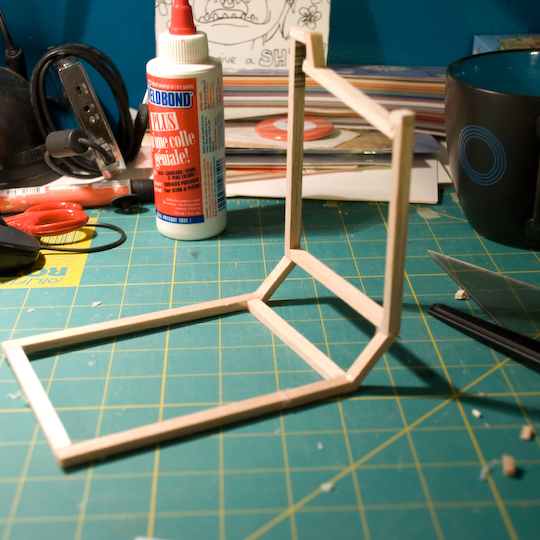


Monday, March 28, 2011

Monday, January 31, 2011
Alëna : Balanza Verde Testing

Phase 3 has brought about many changes in my project, the most crucial one of which is switching to a different target audience for the proposed recycling unit. Although, most of the relevant research has been outlined in my Phase 2 report, further research had to be conducted on the interests and lifestyles of elementary students in Lota.
As briefly described in my last post, one of the most touching experiences I’ve had in Lota was a visit to Escuela Adventista. Speaking with the children about their future, listening to one of the girls play violin, and laughing with them has influenced me greatly. The interviews with the children of Lota indicate that they are concerned with the lack of waste management in the city. This includes improper disposal of waste on the streets of Lota, lack of community engagement in the cleanup process, and aggravation of the problem after the February earthquake. Children feel powerless and lack information or incentive on proper disposal of waste. Since children will ultimately be the decision makers for the community, teaching personal responsibility for solid waste early on can only benefit Lota in later years.
Thus, I have decided to invest my time in waste management education program within schools of Lota that teaches about waste reduction, re-use, and recycling strategies, while engaging the students in the process. The project will address a waste management device for schools of Lota to encourage and educate children about benefits of recycling system.
As a result of my shift in focus, the purpose of the device, its aesthetics, and additional functions have been rethought in a more playful way to encourage children to engage with in the process. The user testing will be conducted on the premises of York Street Public School, with the permission of the parents and the principal. The issues to be addressed are:
- Unit form and its dimensions. This will be tested through a game, in which two teams run to different containers and place respective recyclable/non-recyclable items in them.
- Anticipated mistreatment of the unit. Obviously, it’s a school environment - a child’s creative mind can think of million ways to misuse an introduced artifact.
- Determining the fun and educational factor. A swap-box, in which children can place their newly created recycled art for an exchange of another hand-made masterpiece, is one of the key elements of the unit. Ideally, the model will be left at school over several days after other experiments have been conducted and children are familiar with the idea of a swap-box and its function.
- Maintaining the unit. This test will be conducted during the design charrette in Toronto with my fellow students from IwB and DuocUC. The main purpose of this study is to determine how an adult might clean the unit and refill it with clean bags.
- Understanding the meaning of instructions, labels, and general purpose of the unit. This test will be done with both my fellow students and the children of York Street School. I hope to conduct unstructured interviews with students by placing different labels on the unit and asking them what they want to do when they see this label/colour/picture.


I have built a life-sized model out of cardboard, which I can use in some of the testing. The other three tests will need to be conducted with a wooden model for a sturdier effect. I hope to gain many insights by the end of February.


Phase 3 Update

The main areas I will be addressing through my user testing are:
- portability - the cart will be moved a short distance on a daily basis over somewhat uneven city terrain, such as curbs, bumps or hills. I will be testing 2 different wheel sizes over an obstacle course.
- awning set up and take down - the weather protecting awning is an integral part of the cart. Keeping the fish in the shade, making it comfortable for the vendor to stay there all day in all weather conditions are two priorities.
- storage - the cart will be used to store various elements over night as well and during the day when it is in use. By figuring out how much space is required for this function it will determine how big the cart needs to be.
- visibility - the cart will be approached from all sides, so keeping the product for sale in clear view is an aesthetic and security issue
- setup of display surfaces - will the fold, slide, pivot?


Phase 3: Testing
Since my last post at the end of phase 2 my project has started to take a different direction. I've strayed away from traditional wayfinding to develop a concept that will brand Lota, and improve the state of their public spaces, while still directing visitors to points of interest throughout the city.
The proposed concept will be a public art project to create unique seating solutions for Lota's public spaces. They will be modular and made from a combination of concrete, metal, and possibly wood. The residents of Lota will paint each piece either by themselves or in groups, and then deliver them to a public area for display. It is my hope that the final products be colourful and eclectic. This will, not only draw attention to them from afar, thus, luring curious onlookers into the spaces they inhabit, but will create an interesting visual effect that mimics the colourful, beautiful spirit of Lota and its people and becomes a memorable feature for outsiders.
Because Lota has many graffiti artists, the painted furniture will be painted and altered by them as well, thus changing Lota's landscape as its people change or see fit for it to change.

 During phase 3 we are supposed to develop a test plan to identify which issues need to be tested, and how this will be done. We are also meant to begin building test models for phase 4.
The three pictures to the right illustrate my process of pouring concrete. This was done to create test samples to be painted on during one of my tests, but through working with the concrete I also learned quite a bit and it helped me to refine my test plan further. It helped me to visualize how concrete is mixed and poured and how it settles. It also helped me to get a clear idea of how exactly the final product could be manufactured and it helped me to gain an appreciation for just how heavy concrete is (each 10x10x4 tile I made is approximately 15 pounds).
As far as my test plan itself is concerned, below I have outlined each test to be carried out, and what types of models I will need to produce to complete each test.
Test 1: Formal Configurations
This test will help to refine the final form of my design. In this test I will provide scaled models to users who are familiar with Lota. With these models they will be asked to choose their favorite and arrange them into patterns.
 Test 2: Social interaction
Once an overall form is chosen from test 1. A few fullscale rough models will be produced and subjects will be asked to sit in the chairs in groups of 2 or 3 to have a casual conversation. This test will assess overall comfort, and give me a clear idea of how people will use the product, and how effective its design is.
Test 3: Radii
With full scale models, similar to those used in test 2, I will determine the comfort of the edge radii behind users' knees and on the inside edges of the arm rests.
Test 4: Connectors
After sourcing a number of different connectors, and discussing my project with professionals that have experience using concrete I will attempt to determine the most appropriate method of connecting the furniture to one another so that it is relatively simple to assemble, but more difficult to disassemble to discourage vandalism.
Test 5: Painting
Using the test tiles featured above i will test how paintable the surface is, find out which tools work better than others, and gain an understanding of how the final product will look.
Rahim Bhimani - Phase 3: Testing
Project Description:A toilet system designed to aid individuals trying to recover right after a natural disaster.This toilet system will be a flat-pack system that can easily be shipping following a disaster.The system includes a tent to create awareness of the system and for privacy.
User Scenario:
Following a natural disaster, as aid is being shipped out, these flat pack toilet kits will also be part of the aid/care package.
Criteria:
The idea of the toilet is to be simple enough for any user to easily put it together. Due language barriers, this product must be very intuitive for the user to simply put the together for use. The tent portion of this design is to create awareness and to allow individuals to know that the toilet is located at the specific location of the tent. The Red Cross and universal bathroom symbol will be also located on the tent. The cart is designed so that it can detaches form the toilet and can be easily disposed in a pit solves the issue with the waste.

 The second part of my design is the toilet!


Test 1: Structure/Material: Toilet Strength
Test 2: Folding Mechanism
Test 3: Ease of User
Test 4: Tent Entrance
Test 5: Appearance of the Tent
Wednesday, December 15, 2010
Lota Agua


The project will be focused on a low tech shower and bath with the reuse of grey water for gardens and green space for Lotina communities living on illegal land with no potable water, where the full use cycle is taken into account.
When researching the temporary housing, every interviewee mentioned that their primary issue is water. The issues related to water are mostly political ones, however what the people of Lota in temporary housing need is a reliable system now, not in decades if the political situation is ever resolved. After all water is a basic need for survival.
Currently, there is no running water and transportation, storage and pouring is accomplished through the use of buckets. In some houses, water is stored in large garbage cans. Such communities have no managed method of water disposal and often grey water is poured to a body of water surrounding them. Others wash their bodies, clothes or dishes by the river with toxic chemicals. Most of the housing in illegal land have difficulty washing themselves as there is no running water.
There is opportunity for a personal and possibly communal washing space since the biggest problem is the act of washing and since is no designated space for the disposal of used water, a possible garden. Infact this all can be part of the same system. Currently in the community, buckets are used in order to store, trasport and use as a tool for pouring.
Although many were relocated and the municipality provided materials for housing and some help with plumbing, many people due to delayed allocation of land moved to illegal land where they made their own houses with the supplies given to them. These communities remain with no running water and have simple temporary housing, with temporary bathrooms, no showers and sometimes no stoves. Many still wash their clothes in the body of water nearby and others dispose their water in the dirt pathways around the house where greywater sits and can be more contaminated. I went to several temporary housing communities. The one that made me realize design can be a solution to is temporary housing number one and two. Even when i asked the communities, where do you throw the water you use, they kind of put their head down and said that in the nearby water or road. Infact in the Lota charrette at DUOCUC the residents of lota were very concerned about this issue.


Finally, when i went to the Toronto Charette in November, ironically I had the chance to work with the water group and we designed emergency shipping containers that could serve a need, in this case water. We worked on this project for days and every day at 5:00pm we talked to experts in Water, Industrial Design, Architecture and Development. And what I came to realize is that although basic needs are very important, sometimes design is about added value, its about dignity and about social and psychological aspects. Many of Lotina's needs are met but the in the most crude and uncomfortable way. They CAN wash themselves, they CAN get water to drink but it is not something they look forward to. I want to design a scenario where you look forward to doing the activity.
Imagine:
warm water falls from your shoulders, run down your body slowly, you breathe in, you can feel the warm air, the steam of it all, makes your body relax. As you sit and ponder about the day and the people you are around, you take in slowly the most incredible, indescribable aroma of lavender and herbs that you are softly stepping on. You are sitting in a space where you can gaze in to the ocean, its endless.
As the water drips down your face, down to your chest, to your legs , knees, feet, it finally reaches the ground... now the soil is drinking it in, thirst is replenished and the water runs down travels slowly through the soil, filling every hole where thirst made a home.


This is what I want. I want to create an experience that is much beyond meeting a basic need, because sometimes thats dignity, pride, and a sense of self.
Monday, December 13, 2010
Chile Recicla
Thursday, December 9, 2010
Temporary housing in Lota
Here is a video of a gentleman, who has kindly invited us into his home. This is a typical temporary house, which he built himself following the earthquake. It is so cramped, that most of the things have to be stored outside. The blue bin that you see in the kitchen is a typical container, which is used for storing water, fuel and garbage. Things that should not be compatible. Since HIMCE trucks are not able to go down the roads in these neighbourhoods, he has to transport this giant blue container uphill to one of the main roads.
Phase 2 : Alëna's Summary
 a Verde. It means Green Lota. And Green Lota means a step into sustainability of waste management system that integrates waste re-use and recycling strategies, while engaging the community and improving the economy of the city.
 Solid waste collection and disposal in Chile are the responsibility of municipal governments. Lota was able to secure a contract with empresa HIMCE in 2008 for the removal of solid waste and its transportation to Coronel landfill 12.5 km from the city.
Additionally, a number of people - chatarerros - make their living in the informal waste recycling sector. The groups involved include door-to-door collectors, street scavengers, traders and dealers in waste materials. Such recycling activities are not well integrated into the solid waste collection and disposal system in Lota.

Some of the social costs associated with improper waste disposal include contamination of both surface and ground water, spread of disease, and uncontrolled population of stray animals.
In Lota, the high standard quarters and average standard quarters benefit from house-to-house garbage collection. However, this service is relatively low or non-existent in temporary housing quarters. MSW management is malfunctioning, because of the lack of paved roads - HIMCE trucks are simply not able to reach these dwellings.
The final convincing point was a visit to a local middle school escuela Adventista, where Sam and I along with Miki and Cote (IwB and Duoc students) conducted several exercises. One of which drew from Lorenzo Imbesi idea of a perfect city. The question that we asked during one of the exercises was “What is your ideal city?”. Children filled a sheet of paper with many wonderful features of Lota, including its beautiful parks, and beaches. However, about half of the paper featured phrase “sin basura”, which means “without garbage”. Children, which are supposed to be the future of the city, are concerned with the amount of poorly treated waste on the streets of their city.

The scope of this project allows me to address the design of a waste management container that will be used for transporting sorted solid waste to a neighbourhood transfer station. Further sorting and recycling/reusing operations could be carried out by chatarerros, thus, incorporating informal waste picking within a formal waste management sector. The transfer station will not be addressed to the same extent and detail as the container. However, it is recognized as a key component of a suggested WM system in Lota. Without such transfer station, the waste container will be ineffective.
The development of an artifact to fit within the system will be guided by three design principles.
- Scale and configuration of device should take up minimum space in the home of the resident of Lota.
- When the device is engaged, it should promote recycling , re-use, and proper management of waste, while being comfortable and safe to use.
- The device must be integrated int a natural topography and underdeveloped road system of Lota.
- Quality and comprehensiveness of visual appearance and function of device is vital. Functioning components, such as handles, lids, hinges, etc. should receive careful consideration.


Lota faces the same challenges as many other cities with stagnant economies in terms of poor infrastructure, high prevalence of the informal sector, and poor public awareness on safe domestic waste management techniques. Public awareness is needed, but this could be useless if the community is not actively participating in the process.
The construction of transfer stations would be a good solution to reduce distances between households and waste collection sites. Appropriate waste container for recyclables and other types of solid waste would be complimentary to the proposed station.
Phase 2: Rahim's Summary

The purpose of this project is to design a toilet to aid individuals who lack basic sanitation needs. The focus will be on providing better sanitation methods to individuals living in temporary housing areas, as well as those trying to recover from a natural disaster, both of which do not have basic bathroom facilities. Many countries right now, following a natural disaster are having huge sanitation, for example Haiti right now has a huge Cholera breakout do to waste contaminating with drinking water.


The last option are buckets. Individuals that live in temporary housing that do not belong to a community tend to have it a bit more difficult due to the fact that they don’t have the opportunity to share facilities. These individuals are focused to discard their waste in unauthorized areas, due to the fact of not having proper sanitation needs.


Concept 1 deals with a toilet design that is a flat pack and can easily be snapped together. This concept features a biodegradable bag, which allows the user to put their waste in the bag, and then dispose the bag to a nearby compost bin. This concept ensures that the bag can easily be throw into the compost therefor the waste not coming in contamination with the user or with nearby water supplies.
Phase 2: Sam's Summary


Both of these experiences indicated to me that wayfinding for this city would be an interesting challenge. The three preliminary concepts I have been exploring have to do with further exploring the idea of landmark wayfinding.
Concept one is a city map that visually depicts images of what the user would see around the city. Being able to connect a building you're standing in front of with an image of the same building on a map will hopefully prove to be a simple way of orienting oneself.
Concept two is a site marker that uses the idea of place making to help the user guide themselves. When a user sees a branded sign or area within the city, they will know that they have arrived at a point of interest. The site marker could also display information or a historical background on a given attraction.
Concept three is a path marker. This could be in the form of a medallion that might be inset into the sidewalk or path. The user would follow these "breadcrumbs" from tourist site to tourist site.